
What to do when you don’t need daycare every day? And what today’s Slovakia tells us about parenting
In Slovakia today, fewer children are being born than in the past—and this is no longer just a feeling, but hard data. The Statistical Office of the Slovak Republic reported that in 2025, Slovakia’s population declined for the fifth consecutive year, and the birth rate reached a new historic low in the country’s modern history. At the end of 2025, Slovakia had 5,409,407 inhabitants, more than 10,000 fewer year-on-year.
This topic is sensitive. And it should remain that way.
It’s not fair to talk about families as if they simply “don’t want enough children.” Reality is usually far more complex. Many people do want children—but they face practical barriers, fatigue, uncertainty, high housing costs, difficulty balancing work and family, or a lack of everyday support. In its 2025 report, UNFPA highlights that a large share of people of reproductive age feel they won’t be able to have as many children as they would actually like.
And this is exactly where one important point should be made:
Demographics are not shaped only by big political statements. They are often shaped in very ordinary Mondays, Wednesdays, and Fridays.
When a parent doesn’t know who will look after their child for a few hours.
When they work shifts.
When they don’t have grandparents nearby.
When partners are managing life on their own in Bratislava, solving logistical puzzles every week.
When help is needed not “forever,” but for exactly two days a week, a few hours, or a temporary period.
And suddenly, this is no longer about the abstract term “population crisis.”
It becomes a very concrete question:
How is a modern family supposed to function in practice?
Why fewer children are being born today
There is no single answer. But several factors repeat across Europe and OECD countries.
Eurostat shows that fertility is declining across the EU and that women are having children later in life. In 2024, total fertility in the EU was 1.34 children per woman, and the average age at first birth reached 29.9 years.
The OECD also points out that declining fertility is linked to delaying family formation and reducing the desired number of children. Another key factor is work-life balance: if women have to choose between a career and a family, fertility tends to decline; when work and family can be combined more easily, outcomes are better both economically and demographically.
And here is a particularly important point for Slovakia: the OECD explicitly states that accessible and affordable childcare can have a greater impact on fertility than parental leave policies alone.
That’s a powerful statement.
Translated into plain language:
It’s not enough to tell parents that family is important. You have to help them manage real life.
Not every parent needs daycare every day
And this brings us to what we address at Carnival.
Many parents are not looking for the traditional “Monday to Friday, every day the same” model.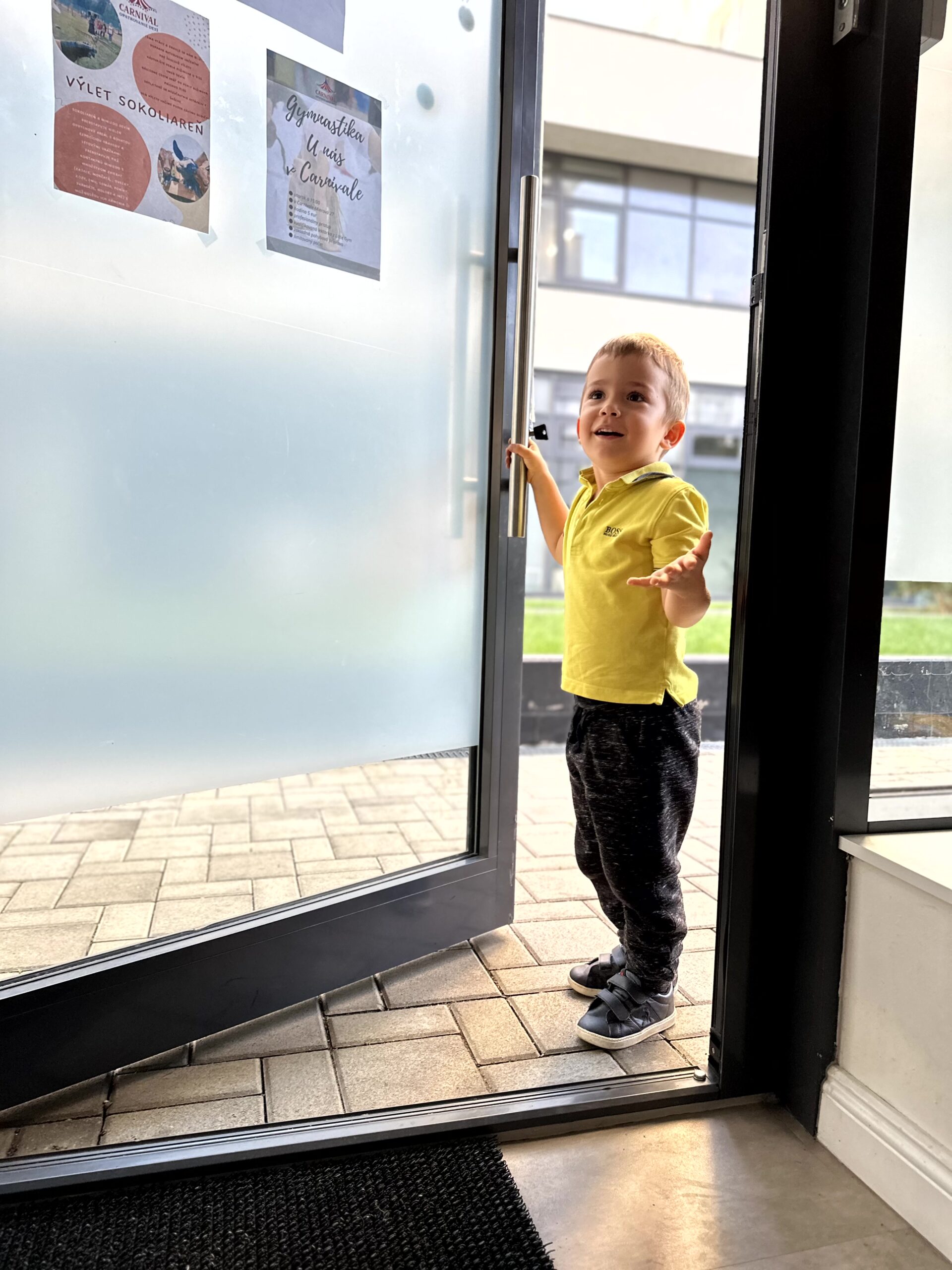
Instead, many are looking for:
- daycare only a few days a week
- help only in the morning or for a few hours
- part-time arrangements
- short-term solutions for a week or two
- evening or overnight care
- the ability to adjust attendance based on work changes
And this is not a luxury.
This is the reality of modern parenting.
Some people work in healthcare.
Some in hospitality.
Some have hybrid work schedules.
Some move to Bratislava and suddenly find themselves without a family support network.
Some are foreigners or expats with no relatives or close contacts to rely on.
For these parents, a non-rigid model makes sense.
Carnival in Ružinov: when support is not theory, but a service
At Carnival in Ružinov, we operate in a way that allows childcare to adapt to life—not the other way around.
We offer multiple options:
- full-month programs
- part-time attendance
- flexible schedules
- hourly childcare
- overnight stays
In practice, this means a parent doesn’t have to say:
“I need daycare for the whole week.”
They can also say:
- I need 2 days per week
- I only need a few hours
- I need help for two weeks
- my work schedule is changing
- this month I need more, next month less
- I need evening or overnight support
And we don’t look for reasons why it won’t work.
We look for ways to make it work.
Flexibility does not mean chaos
This is important to say clearly.
A child needs safety, rhythm, and predictability.
A parent needs flexibility, because life today is often unpredictable.
These two things are not in conflict.
Reasonable flexibility is not chaos.
It’s an agreement.
It’s a thoughtful setup that makes sense for both the child and the parent.
And that is often the difference between a system that burdens families and one that truly supports them.
If we want families to live more easily, we need to make everyday weeks easier
The debate about why fewer children are being born in Slovakia often turns into big judgments, emotions, and ideology. But the average parent does not live in ideology. They live in a calendar.
They deal with:
- who picks up the child
- who watches the child
- what if they have a night shift
- what if they have a meeting
- what if their partner is on a business trip
- what if both are exhausted and without help
And this is exactly where quality childcare services can make a huge difference. Not as a magical solution to everything, but as real support that reduces stress, improves family functioning, and gives parents more space to manage life with dignity.
Conclusion: parents don’t just need talk about supporting families. They need support that actually works.
Fewer children are being born in Slovakia, and it is clear that appeals or one-time financial incentives alone will not solve the issue. International data suggests that the ability to balance work and family life—and access to childcare—plays a crucial role.
Carnival does not want to exploit this topic.
But it aims to be one of the practical answers to what parents are actually experiencing.
If you don’t need daycare every day,
if you are looking for part-time options,
if you need hourly childcare in Bratislava,
if you are dealing with shifts, changing schedules, evenings, or overnight care,
if you are in Bratislava without extended family and need reliable help,
Carnival Ružinov can find a solution that works for both you and your child.
FAQ
What should I do if I don’t need daycare every day?
One option is part-time or individually tailored attendance. Not every family needs the standard Monday–Friday routine.
Is there daycare in Bratislava for just a few days a week?
Yes, some facilities offer more flexible attendance models. At Carnival Ružinov, we can tailor a schedule to your family’s needs.
Who is hourly childcare suitable for?
Especially for parents who need a few hours for work, errands, rest, doctor visits, meetings, or unexpected situations.
Can daycare be adapted for parents working shifts?
Yes. Flexibility is especially important for shift work. The key is to maintain as much predictability for the child as possible and communicate changes in advance.
Does short-term childcare (a week or two) make sense?
Yes. Sometimes families need temporary help rather than a long-term solution—and this can be very valuable.
Contact
Carnival – Bratislava, Ružinov
Ivana Kružlíková
📞 +421 915 246 038